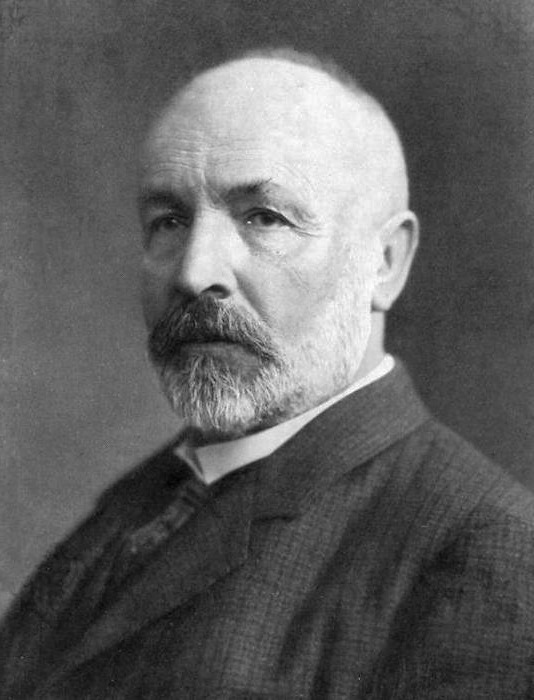
In his doctoral thesis, Georg Cantor wrote that "in mathematics, the art
of asking questions is more valuable than solving problems" (Cantor,
1867). It is no surprise, then, the boldness with which he delved into
research that many considered foolish, especially if we remember that he
was trained in mid-19th century Germany, when the neo-humanist movement
encouraged mathematicians to think in more creative, imaginative, and
abstract ways.
With this intellectual curiosity, Cantor dared to
challenge the status quo by asking: "Does the same amount of natural
numbers (\(\mathbb{N}\)) exist as real numbers (\(\mathbb{R}\))?".
To understand how Cantor arrived at his answer, first consider a more
everyday case: how do you know if there are more women than men in the
country? Counting them would seem the most direct way, but it would be an
enormous task. A more practical alternative consists of pairing each woman
with a man: if there are men left over, there are more men; if there are
women left over, there are more women; and if no one is left over, both
quantities are equal (Lemismath, 2017).
Cantor did something similar with sets. Instead of
counting their elements, he established one-to-one correspondences to
determine which set was truly larger. Thus, he discovered that there are
infinities that, although different at first glance, have the same size
and, furthermore, that there are infinities strictly greater than others.
Think of the natural numbers and the perfect squares:
$$\mathbb{N} = \{1, 2, 3, 4, 5, 6, 7, 8, 9, 10, \dots\}$$
$$\square^2 = \{1, 4, 9, 16, 25, 36, 49, 64, 81, 100, \dots\}$$
At first glance, it might seem that there are more naturals than perfect squares. But, by pairing them like this:
$$\{\mathbb{N}, \square^2\} = \{\{1,1\}, \{2,4\}, \{3,9\}, \{4,16\}, \dots, \{n,n^2\}, \dots\},$$
none are left without a partner. That is to say, there are as many perfect
squares as there are natural numbers! In fact, Cantor proved that
\(\mathbb{N}\), \(\mathbb{Z}\), \(\mathbb{Q}\), and \(\square^2\) have the
same quantity of elements.
Any set that can be paired one-to-one with
\(\mathbb{N}\) is called countably infinite and is represented by
\(\aleph_0\) (Aleph-null).
After this breakthrough, Cantor decided to compare the real numbers with the natural numbers. To simplify, he restricted the problem to the interval \((0,1)\). He paired both sets in the following way:
Cantor showed that, from this list, an unpaired number can always be
constructed. The rule is simple: for the \(n\)-th decimal of the new
number, take the \(n\)-th decimal of the \(n\)-th number and change it to
any other digit. A possible number would be \(0.23456\dots
[n+1]000\dots\), which differs from the first in its first decimal, the
second in its second, and so on.
This proves that in the interval \((0,1)\) there
are numbers that cannot be paired with the naturals: the set of reals in
\((0,1)\) is much larger than \(\mathbb{N}\). In reality, infinitely
larger. Infinities greater than others exist!
When Cantor published these ideas, a large part of the mathematical
community rejected them. Even Leopold Kronecker, his former mentor,
described his conclusions as unacceptable.
The resistance was due to the dominant
idea of infinity being the one taught in basic courses (limits, series,
integrals). This is now called potential infinity: a quantity that can
grow or decrease without limit. However, operating with it leads to
indeterminate forms like \(\frac{\infty}{\infty}\) or \(\infty - \infty\).
Because of this, many mathematicians
refused to accept infinity as an entity with its own size. In the words of
Carl Friedrich Gauss: "The use made of an infinite magnitude as a real
entity is never admissible in mathematics. Infinity is only a way of
speaking."
Unfortunately, the controversy over his mathematics, combined with nervous
breakdowns and the deaths of his mother, brother, and youngest son, led
him to spend much of his life in the Halle psychiatric hospital.
However, over time, the scientific community began
to recognize the value of Cantor's work. Today, much of modern mathematics
is based on Set Theory, which could not have developed without his
discoveries. Cantor allowed mathematicians to touch infinity.
"No one shall expel us from the paradise that Cantor has created for us." — David Hilbert